

Movement trays: which size for round and square bases, magnets, and ranking up a unit
Pick a movement tray by two things: the size and shape of your bases, and the formation you rank up in. A unit of 20 on 25mm square bases needs a 5 × 4 tray for 25mm squares, about 133.5 × 108.4 mm outside, and round bases need a tray with a socket for every base or a conversion tray that turns them square.

Updated 10 min read28mm

On this page
Pick a movement tray by two things: the size and shape of your bases, and the formation you rank up in. A unit of 20 on 25mm square bases needs a 5 × 4 tray for 25mm squares, about 133.5 × 108.4 mm outside, and round bases need a tray with a socket for every base or a conversion tray that turns them square. This guide covers which tray fits which base, how tray sizes are worked out, how to add magnets and how to rank up a unit without leaving gaps, with the sizes of our own trays and other makers worth knowing.
- Bases covered
- 20, 25 and 30mm square, 25 × 50 and 30 × 60mm cavalry, 25 and 32mm round
- Scale
- 28mm ranked units (10mm and 15mm: see below)
- Magnets
- Optional, 5 × 2 mm in our trays
- Our trays
- Movement Trays, A$7–20
What is a movement tray for?
A movement tray is a flat plate with a low rim that holds a whole unit's bases in rank and file, so you move twenty figures in one go instead of nudging twenty bases one at a time. It keeps the block square when you wheel or charge, stops the back rank drifting, and makes it far less likely a figure topples off the table edge. In mass battle games where units fight as blocks, it's the single biggest time saver on the table.
The tray doesn't replace the bases: each figure stays on its own base, so you can still take casualties off, swap a champion in or break the unit up. That's the difference from the multi-bases used at 10mm and 15mm, where the figures are glued to one stand for good (more on that in how to base 10mm and 15mm armies on multi-bases).
Which movement tray fits which base?
Match the tray to the base footprint first and the formation second. These are the bases most ranked 28mm units stand on, and what holds them:
| Your bases | Tray to use | Our formations | Our 5 × 4, outside |
|---|---|---|---|
| 20 × 20mm square | 20mm square tray | 4 × 2, 5 × 2, 6 × 2, 5 × 3, 5 × 4, 5 × 1, 10 × 1 | 108.5 × 88.4 mm |
| 25 × 25mm square | 25mm square tray | 4 × 2, 5 × 2, 6 × 2, 5 × 3, 5 × 4, 5 × 1, 10 × 1 | 133.5 × 108.4 mm |
| 30 × 30mm square | 30mm square tray | 5 × 1, 5 × 2, 5 × 3, 5 × 4 | 158.5 × 128.4 mm |
| 20 × 40mm cavalry | 20mm square tray, each horse across two ranks | 4 × 2, 5 × 2, 6 × 2 and 5 × 4 trays | Two ranks of five |
| 25 × 50mm cavalry | 25mm square tray, each horse across two ranks | 4 × 2, 5 × 2, 6 × 2 and 5 × 4 trays | Two ranks of five |
| 30 × 60mm cavalry | 30 × 60mm cavalry tray (or the 30mm square 5 × 2 and 5 × 4) | 5 × 1, 5 × 2 | 5 × 2: 158.5 × 128.2 mm |
| 32mm round | 32mm round tray, a socket per base | 5 × 1, 4 × 2, 5 × 2, 6 × 2, 5 × 3, 5 × 4 | 174.9 × 141.2 mm |
| 25mm round | A 25mm round tray or a round-to-square conversion tray (we don't make these) | See other makers below | Check the maker's size |
Formations are written bases across × ranks deep, so a 5 × 4 is five wide and four deep: a block of 20. A 4 × 2 holds 8, a 6 × 2 holds 12 and a 5 × 3 holds 15. Every one of our trays has a magnet recess under each base, and the cavalry trays have it under the middle of each horse.

How is a movement tray's size worked out?
For square bases it's simple arithmetic: the number of bases across times the base width, plus a little play so the bases drop in, plus the rim on both sides. Our 25mm 5 × 4 is 5 × 25 mm = 125 mm of bases, 0.5 mm of play (0.1 mm a base) and a 4 mm rim each side, so 133.5 mm wide. The depth works the same way: 4 × 25 mm, 0.4 mm of play and two rims make 108.4 mm.
Round bases are different. Five 32mm rounds touching would be 160 mm wide, but a tray that holds round bases firmly gives each one its own socket, with a wall between neighbours. Ours have a 1.6 mm wall, so the 32mm 5 × 2 is 174.9 mm wide. If your rules measure a unit by its bases, measure the bases, not the tray: the tray just carries them.
Round or square bases: which is easier in a tray?
Square bases are the easy case. They butt edge to edge, so a unit forms a solid block, the tray is barely bigger than the unit, and cavalry on double-length bases simply sits across two ranks of the same tray. That's why ranked mass battle games have traditionally used squares.
Round bases leave diamond-shaped gaps between them and roll around in a plain tray, so you have three choices:
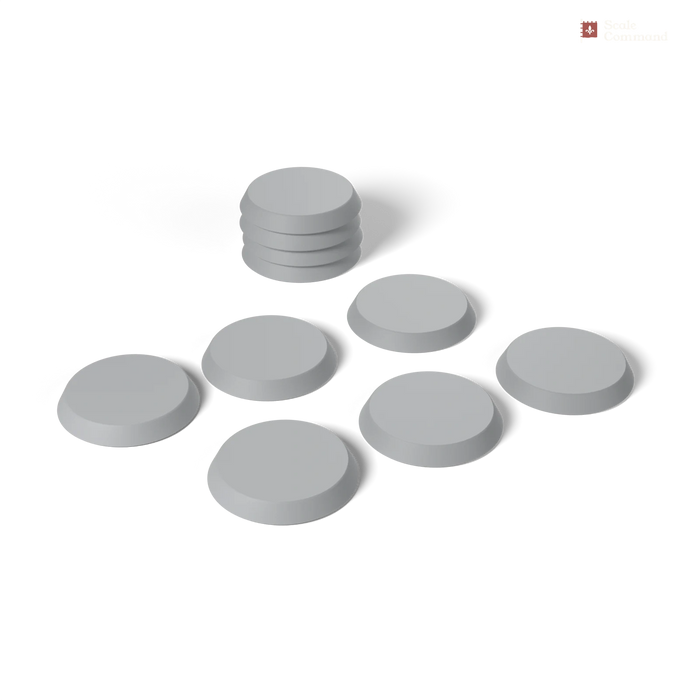
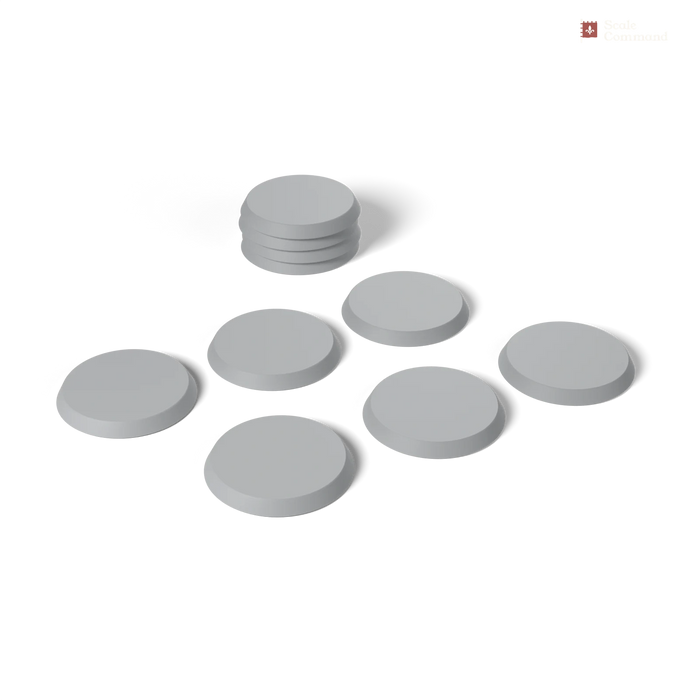
- A tray with round sockets. Each base sits in its own recess and can't slide. Our 32mm Round Movement Trays work this way, from a line of five up to a 5 × 4.
- A conversion tray. A small square plate with a round recess that turns each round base into a square one, so it fits a normal square tray. Warsenal makes them for 25mm rounds.
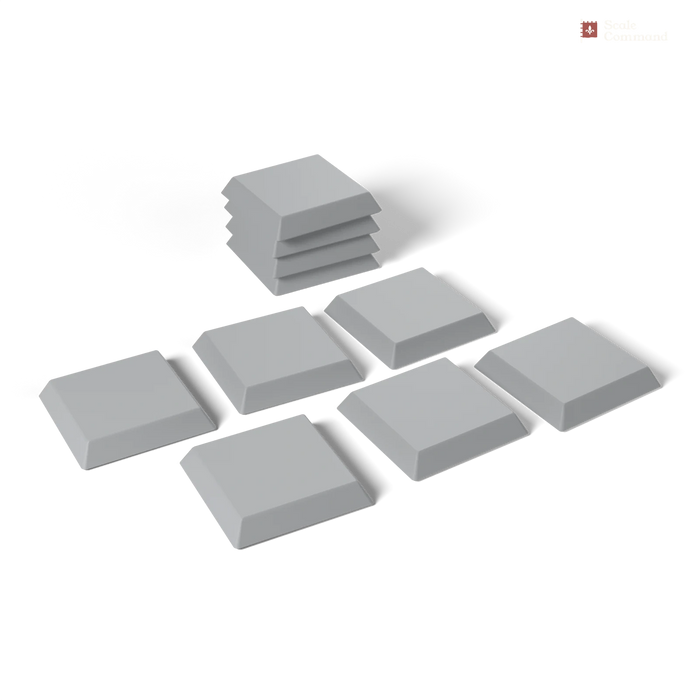
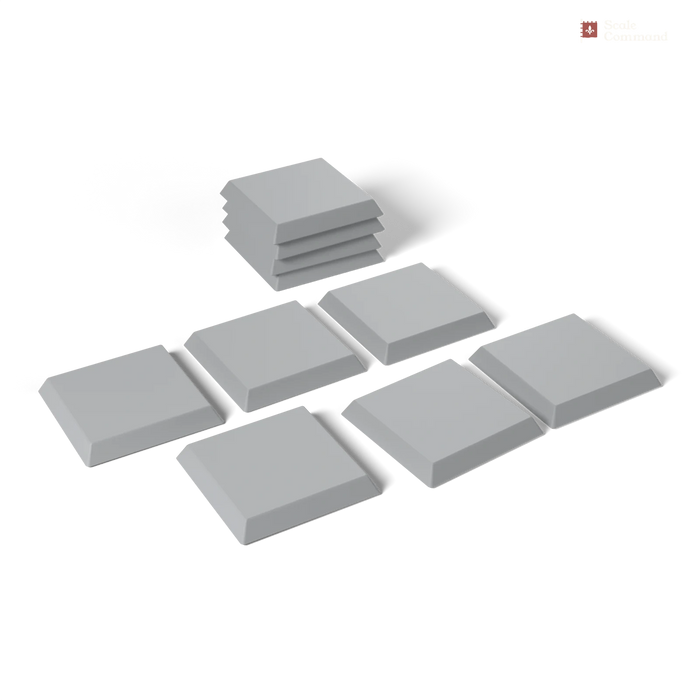
- Rebase onto squares. If you're starting a new army for a game that uses squares, it's often simplest to base it on squares from day one: our Square Bases come in 20 × 20, 25 × 25, 25 × 50 and 30 × 60mm.

We make the round trays for 32mm because that's the base our 28mm Reconquer Designs figures come with by default (they arrive without bases, so we add one per model for free). For 25mm rounds, look at Renedra's plastic trays with round insets, or Warsenal's conversion trays.
Do cavalry bases fit infantry movement trays?
Yes, when the cavalry base is exactly twice the depth of the infantry base. A 25 × 50mm horse fills two 25mm squares, so it sits across two ranks of a 25mm square tray: four horses side by side in the 4 × 2, five in the 5 × 2, six in the 6 × 2 and two ranks of five in the 5 × 4. 20 × 40mm cavalry does the same in 20mm square trays, and 30 × 60mm fits the 30mm square 5 × 2 and 5 × 4.
The one catch is magnets. In an infantry tray the recesses sit under the middle of each square, so a cavalry base lines up with them only if it has a magnet in each half. If you want one magnet under the middle of each horse, use a tray made for cavalry, like our 30 × 60mm Cavalry Movement Trays.

How do you make a magnetic movement tray?
Magnets stop bases sliding out when you tilt the tray, which matters most on hills and when you pick a unit up to measure under it. You need a magnet in the tray under each base, and a magnet or a steel disc under each base to grip it.
-
Pick the magnet size
Every recess in our trays is 5.2 mm across and 1.3 mm deep, and fits a 5 × 2 mm disc magnet. The magnet stands about 0.7 mm proud of the tray floor, so it seats into the magnet recess or hollow underside of a base. Magnets aren't included with our trays.
-
Mark the poles before you glue
Stack all your magnets in one column and mark the top face of the whole stack with a paint pen. Every tray magnet goes in marked face up, and every base magnet goes in marked face down, so they always attract. Getting one backwards is the most common mistake, and a reversed magnet pushes its base out of the tray.
-
Glue the tray magnets in
Put a small drop of superglue in each recess and press the magnet in with the end of a cocktail stick, not a metal tool (it'll jump to the tool). Let the glue cure before you put any bases on.
-
Fit the bases
Glue a matching magnet into each base's recess, or a thin steel disc if you'd rather the bases don't stick to each other in the box. Test one base in the tray before you do the whole unit.
Magnets are optional. Our trays hold bases snugly with only 0.1 mm of play per base, and a base that's solid and flat underneath, like our resin bases, sits in the tray just as well without one.
How do you rank up a unit in a movement tray?
- Choose the frontage first. Five wide is a common block. A wider front, six across, puts more figures in combat; a deeper unit is narrower to manoeuvre. Pick the tray to match what your rules reward.
- Front rank first. Put the command figures (leader, standard and musician) in the front rank, usually in the middle, then fill the ranks behind.
- Take casualties from the back. Many rules remove figures from the rear rank, so an empty place at the back of the tray is normal. The rim keeps the rest square.
- Add a rank with a single line. A 5 × 1 tray behind a 5 × 2 gives you three ranks of five; a 5 × 4 and a 5 × 1 make 25. Our 20mm and 25mm square trays also come in a 10 × 1 line.
- Paint the tray. Grey PLA takes primer and paint, so give the rim the same colour as your base rims and the unit reads as one block across the table.

Other movement tray makers worth knowing
We'd rather you get the right tray than ours. If we don't make your size, these are well known:
- Litko: laser-cut trays in a wide range of base sizes and formations, plus its own basing guides.
- Renedra: plastic bases and movement trays, including trays with insets for 25mm round bases.
- Warsenal: conversion trays that let round bases sit in square trays.
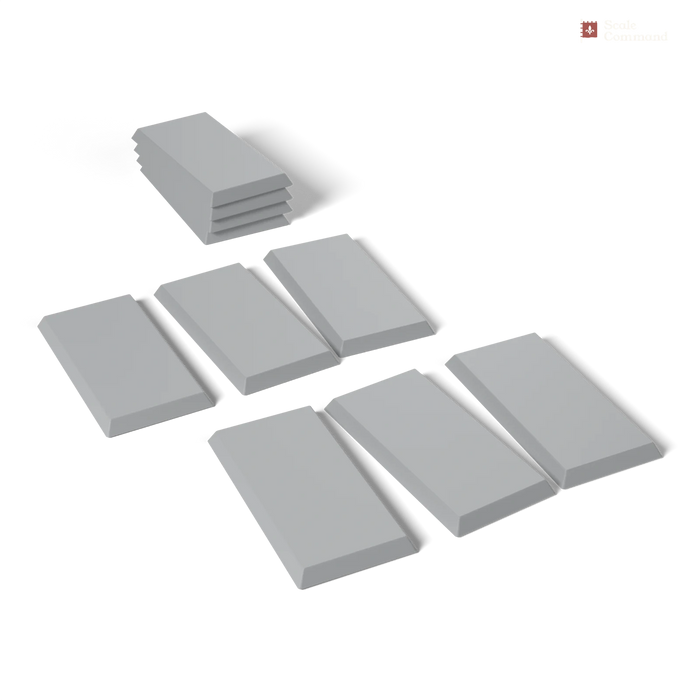
Ours are designed and 3D printed to order in grey PLA in our Perth workshop, in one solid piece 4.9 mm tall, with a 4 mm bevelled rim and a flat underside. The rim stands 2.9 mm above the floor, so bases stand a little proud and lift out easily.
Do you need movement trays at 10mm and 15mm?
Usually not. At 10mm and 15mm a unit is normally a few figures glued to one stand, and the stand itself moves as one. Our Movement Plates are 40 mm wide in four depths, and they come free with our 10mm and 15mm units. The full method is in how to base 10mm and 15mm armies on multi-bases, and the earth-and-rock finish for any base is in our basing guide.
Move the whole unit at once. Our Movement Trays come in 20, 25 and 30mm square, 30 × 60mm cavalry and 32mm round, in every formation from a line of five to a block of 20, with a magnet recess under every base.
See the movement trays



Questions and answers
- What size movement tray do I need for 25mm square bases?
- Count the bases across and the ranks deep, then pick that formation in a tray made for 25mm squares. A block of 20, five wide and four deep, needs a 5 × 4 tray; ours is 133.5 × 108.4 mm outside. Ten in two ranks needs a 5 × 2, and a single rank of five a 5 × 1.
- Can round bases go in a square movement tray?
- Not well: round bases leave gaps and slide about in a plain square tray. Use a tray with a round socket for every base, like our 32mm round trays, or fit each base into a square conversion tray, which Warsenal makes for 25mm rounds. For a new army, basing on squares from the start is simplest.
- What magnets fit Scale Command movement trays?
- Each recess in our trays is 5.2 mm across and 1.3 mm deep and fits a 5 × 2 mm disc magnet, which stands about 0.7 mm proud so it seats into a base's magnet recess. Magnets are not included. Bases that are solid and flat underneath sit in the trays snugly without any magnets.
- How do you magnetise a movement tray?
- Stack all the magnets and mark the top face of the stack. Glue each tray magnet into its recess marked face up with a small drop of superglue, then glue a magnet marked face down, or a thin steel disc, under each base. Test one base before doing the whole unit, and keep loose magnets away from children.
- Do cavalry bases fit infantry movement trays?
- Yes, when the cavalry base is twice the infantry base's depth. A 25 × 50mm horse spans two ranks of a 25mm square tray, 20 × 40mm fits 20mm square trays and 30 × 60mm fits 30mm square trays. Magnets line up only if each cavalry base has one in each half; otherwise use a cavalry tray.
- Do you need movement trays for 10mm and 15mm armies?
- Usually not. At 10mm and 15mm the figures of a unit are normally glued to one multi-base, which moves as a single stand. Our 40 mm wide movement plates come in 15, 20, 30 and 40 mm depths and are included free with our 10mm and 15mm units, so a separate tray is rarely needed.
Shop this article
-
-
-
-
-
-
-
 New