


How to base 10mm and 15mm armies on multi-bases
To base a 10mm or 15mm army, glue each unit's figures onto shared stands, usually 40 mm wide with a depth set by troop type, then texture, paint and flock the whole stand as one piece. Check your rule set for the frontage, the depth and how many figures go on each stand before you glue anything, because the stand, not the figure, is what the rules move and measure.

Updated 7 min read10mm · 15mm

On this page
To base a 10mm or 15mm army, glue each unit's figures onto shared stands, usually 40 mm wide with a depth set by troop type, then texture, paint and flock the whole stand as one piece. Check your rule set for the frontage, the depth and how many figures go on each stand before you glue anything, because the stand, not the figure, is what the rules move and measure. This guide covers the common stand sizes, how to lay figures out on them, and the finish we use on the stands in our own studio.
- Time
- An evening for a unit, plus drying
- Level
- Beginner
- Stands
- 40 mm wide, 15–40 mm deep
- Plates
- Movement Plates, free with our 10mm and 15mm units
Why are 10mm and 15mm figures based in groups?
At 28mm each figure has its own base and a unit moves on a movement tray. At 10mm and 15mm a single figure is too small to handle and too light to stay standing, so the figures of a unit are glued in a group onto one stand, called a multi-base or element. Several figures to a stand and a few stands to a unit, and an army of a few hundred figures becomes a few dozen stands you can push around the table quickly.
It also looks better. A stand of figures with shared ground under them reads as a body of troops, and at arm's length the eye sees the whole block, not each figure. That's the scale's main appeal: big battles that look like big battles. If you're still choosing between scales, see 10mm, 15mm or 28mm.
What size bases for 10mm and 15mm?
The most common frontage for 15mm historical armies is 40 mm, the width used by DBA and the rule sets that grew from it. The same 40 mm frontage is common at 10mm too, so one set of stands can work across several rule sets. The depth then depends on the troop type: shallow for close-order foot, deeper for loose foot and cavalry, square for elephants, war machines and command.
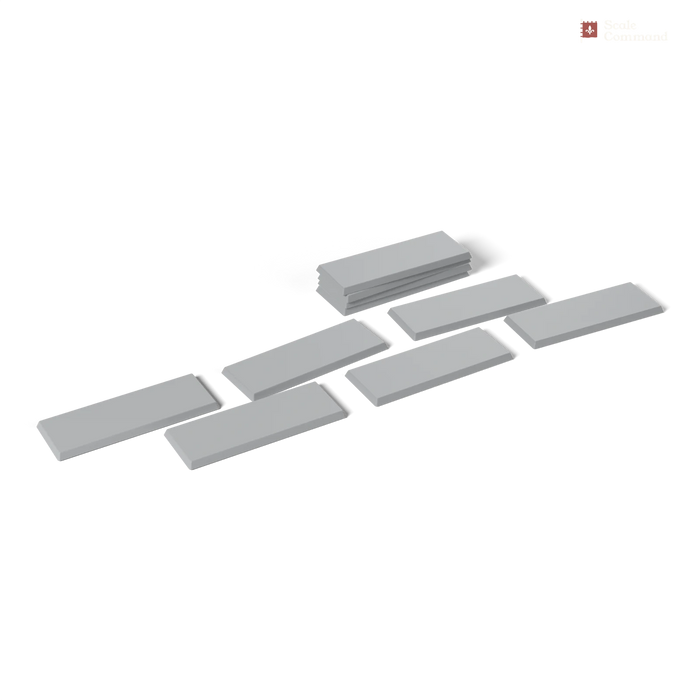
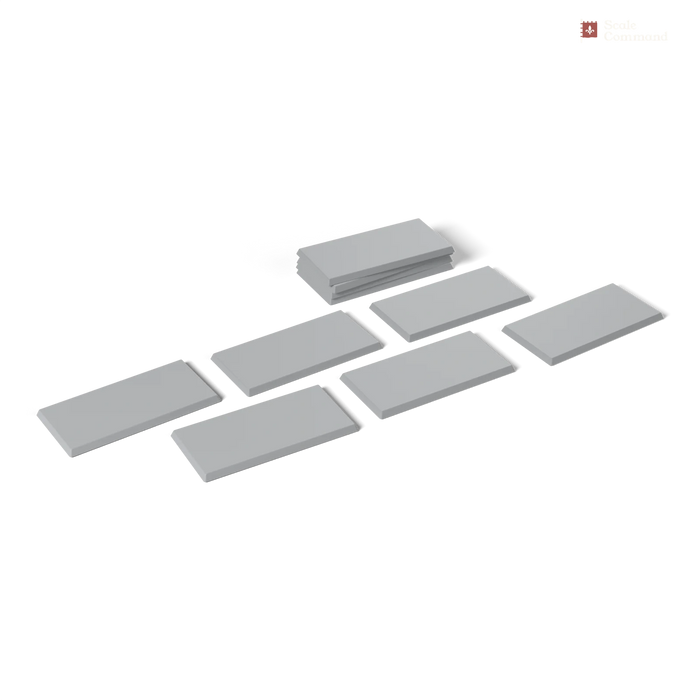
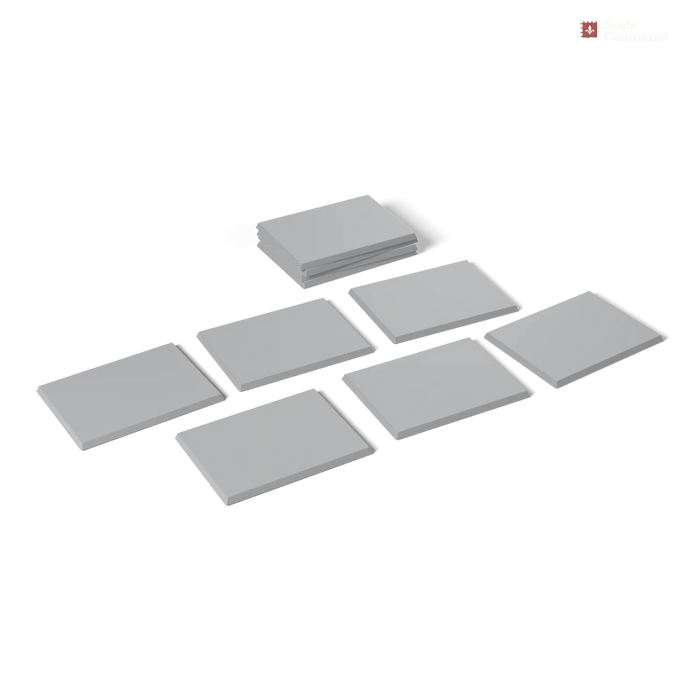
Our Movement Plates are 40 mm wide in four depths, 2 mm thick like the usual card or MDF stands, with a shallow slope round the edge. They're their full size where they meet the table, so neighbouring stands line up edge to edge, and the flat top is 38.4 mm wide.
| Plate | Flat top | Good for | Pack of 10 |
|---|---|---|---|
| 40 × 15mm | 38.4 × 13.4 mm | Close-order foot in a single rank | A$2 |
| 40 × 20mm | 38.4 × 18.4 mm | Foot in two ranks, cavalry facing the short edge | A$3 |
| 40 × 30mm | 38.4 × 28.4 mm | Cavalry | A$4 |
| 40 × 40mm | 38.4 × 38.4 mm | Deep units, command stands, war machines, elephants | A$9 |

Base sizes by rule set
Rules change between editions, so treat this as a starting point and check the basing page of the edition you play:
| Rules | 15mm frontage | Depth |
|---|---|---|
| DBA | 40 mm | Set by troop type: four 15mm swordsmen go on 40 × 15 mm, an elephant on 40 × 40 mm |
| DBMM | 40 mm | Set by troop type: check your rules |
| L'Art de la Guerre (ADLG) | 40 mm | Varies by troop type: check your rules |
| Field of Glory | 40 mm | Varies by troop type: check your rules |
| Kings of War, SAGA and others | Their own basing and unit sizes: check your rules | |
For 10mm, check what your rules say for that scale: some use the 15mm sizes, some their own. If you play several games, 40 mm frontage stands are the safest bet, and Litko publishes basing guides for many historical rule sets if you want to compare.
What do you need to base 10mm and 15mm figures?
Stands
- Our Movement Plates, or MDF, card or plastic stands from makers like Litko or Renedra
- Your 10mm or 15mm figures
Texture
- The finest sand you can find, with PVA glue
- Or a texture paste, or filler mixed with sand
Paint and finish
- A dark earth, a brown wash and a light drybrush colour
- Static grass or flock, and very small tufts
- One colour for every stand's rim
Tools
- Flush cutters and a hobby knife
- Superglue, PVA and an old brush
- Tweezers, and a small soft drybrush
Step by step
-
Plan the stands from your rules
Work out how many stands each unit needs, which depth each troop type takes and how many figures go on each. Write it down per unit before you start: it's much easier than prising figures off later. When you order our 10mm and 15mm units, the plates are already picked for you: 40 × 20mm for foot and 40 × 30mm for mounted figures, enough for the whole set.
-
Prepare the stands
Our plates ship washed and cured on their print sprue. Snip each one free with flush cutters and scrape the contact points smooth with a hobby knife. MDF stands only need the fluff sanding off their edges.
-
Decide when to paint the figures
There are two good ways. Paint the figures on a handle or their strips first and glue them down afterwards, which makes it easy to reach the faces and the back rank. Or glue them to the stand first and paint the stand as one piece, which is quicker for big units. Figures cast or printed on strips suit the second way, because a strip is already a group.
-
Lay the figures out
Dry-fit the figures before any glue. Keep everything inside the flat top so the stands still butt together, and keep the front rank close to the front edge, where most rules measure from. For close-order troops, two neat ranks; for loose troops, stagger them so no two line up. Put a command figure in the middle of the front rank on a general's or leader's stand.
Two ways to fill a 40 × 20mm plate at 10mm: two of Wakes Emporium's 36.5 × 6.8 mm strips, or four figures on Ten Kingdoms' small footplates, spaced across the front. Drawn to scale. -
Glue them down
A small drop of superglue under each figure or strip is plenty. Work on one stand at a time, and check the stand from the front before the glue grabs: a figure leaning forward shows across the whole unit.
-
Fill the gaps with texture
Brush PVA into the spaces between the figures, right up to the footplates and strips, and dip the stand in fine sand. Build it up slightly against the strips so they sit in the ground, not on it. Kallistra's guide for its 12mm figures fills the gaps with dark wood filler mixed with silver sand, which hides strip edges well too.
-
Paint the ground
Basecoat the ground one dark earth colour, wash it brown and drybrush it lightly with a small soft brush. Keep it simple: at this size broad colour does the work. The full recipe, with paints, is in our basing guide.
-
Add grass in patches
Dab PVA in two or three patches per stand and sprinkle static grass or flock over it, then tip off the loose fibres. Leave some earth showing. Big tufts and 28mm basing bits are too tall at this scale and hide the figures, so keep to the smallest tufts you can find.
-
Paint the rim and label the stand
Paint every stand's edge the same colour across the whole army: it ties the force together on the table. Once it's dry, write the unit's name on the underside, which saves a lot of guessing when the army comes out of its box.

Which of our models come with plates?
Our 10mm and 15mm units come with free movement plates, picked by default when you choose the scale. Wakes Emporium's 10mm figures come on strips 36.5 mm long, two to a 40 × 20mm plate; Ten Kingdoms' 10mm and 15mm figures stand on small footplates that glue straight on. If you order a set Tabletop Painted, it arrives mounted and painted on its plates.
- See all 10mm models, including our 10mm fantasy range
- See all 15mm models, such as Ten Kingdoms' 13th Century European Crossbow Foot
- Whole armies at once: army bundles
Stands for the whole army. Our Movement Plates come in packs of ten in 40 × 15, 20, 30 and 40mm, in grey resin, ready to clip, glue and paint.
Get the movement plates-
-
 New
Infantry
-
 New
ArchersTen Kingdoms Miniatures 13th Century European Crossbow Foot Archers · 16 models From $16.0028mm & 15mm & 10mm



Questions and answers
- What size bases do you use for 15mm figures?
- Most 15mm historical rules use stands 40 mm wide, the frontage from DBA, with a depth set by troop type. In DBA four swordsmen go on a 40 × 15 mm stand and an elephant on 40 × 40 mm. Other rule sets vary the depths, so check the basing page of the edition you play before gluing.
- How many 10mm or 15mm figures go on one base?
- Your rules decide, and it changes with troop type: close-order foot is packed tighter than loose skirmishers or cavalry. In DBA four 15mm swordsmen share one stand. The free plates with our 10mm and 15mm units allow four foot figures per 40 × 20mm plate, or two of Wakes Emporium's 10mm strips.
- Should you paint 10mm figures before or after basing?
- Both work. Painting on a handle or on the strips first makes faces and back ranks easy to reach, then you glue them down and finish the ground. Gluing first and painting the stand as one piece is quicker for big units. Figures on strips suit gluing first, because a strip is already a group.
- Can 10mm and 15mm armies use the same bases?
- Often, yes. Stands 40 mm wide are common at both scales, so one set of plates can suit several rule sets. Some rules give 10mm its own sizes, so check yours first. Our Movement Plates are 40 mm wide in 15, 20, 30 and 40 mm depths and are sold for both 10mm and 15mm.
- Do you need basing bits on 10mm and 15mm stands?
- Keep them small or leave them out. Sculpted basing bits and big tufts made for 28mm stand taller than a 10mm figure's knees and hide the troops. Fine sand, a drybrushed earth colour and a few patches of static grass or flock look right at this size and keep the stand readable from across the table.
Shop this article
-
-
New
Infantry
-
New
ArchersTen Kingdoms Miniatures 13th Century European Crossbow Foot Archers · 16 models From $16.0028mm & 15mm & 10mm
-
New
InfantryTen Kingdoms Miniatures Medieval Indian Armoured Spear Foot Infantry · 8 models From $8.0028mm & 15mm & 10mm


